This reference architecture describes how to implement real-time fraud detection on MongoDB Atlas using operational transaction data, vector embeddings, and dynamic risk models.
The architecture ingests transactions, generates embeddings to capture behavioral patterns, retrieves similar historical events with MongoDB Atlas Vector Search, and combines similarity scores with deterministic risk models to reach an approve, step-up challenge, or decline decision. Risk models and watchlists are stored in MongoDB collections. MongoDB Change Streams propagate updates to screening services in real time so that production decisions always use the latest logic.
Diagram
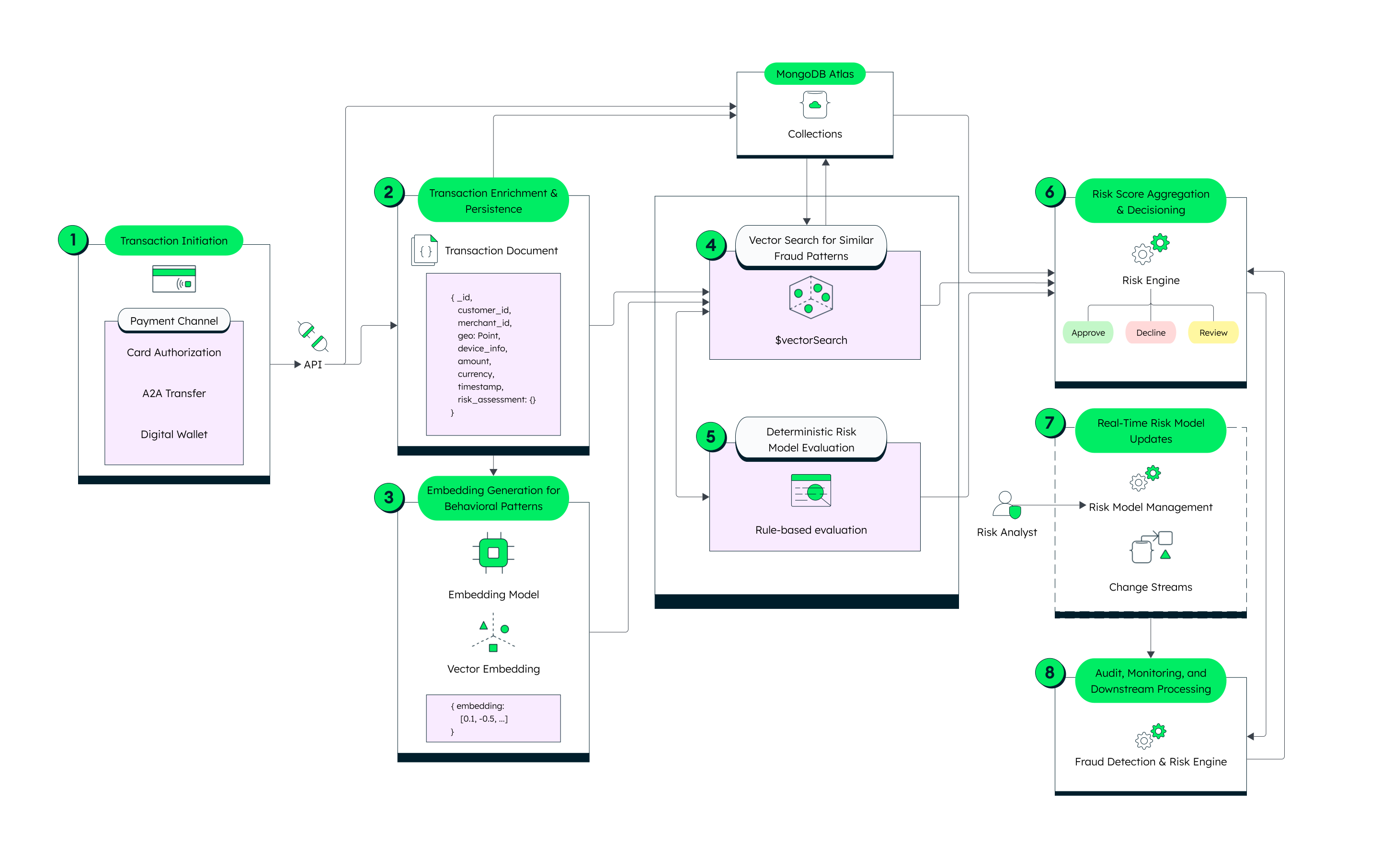
Figure 1. Fraud Detection Reference Architecture
Data Flow
Transaction initiation
A payment channel (for example, card authorization, account-to-account transfer, or digital wallet) sends a transaction request to the fraud detection API. The request includes customer identifiers, merchant data, channel metadata, device fingerprints, IP information, and basic transaction attributes such as amount, currency, and timestamp.
Transaction enrichment and persistence
The fraud detection service validates the request and writes a transaction document into a transactions collection in MongoDB Atlas. Each document embeds merchant details, GeoJSON location, device information, and a nested
risk_assessmentstructure that stores scores, flags, and diagnostics.Embedding generation for behavioral patterns
The service generates a vector embedding that captures categorical and behavioral aspects of the transaction, such as merchant category, channel, device fingerprint, IP range, temporal patterns, and any narrative fields. It stores this embedding alongside the operational fields in the same transaction document.
Vector search for similar fraud patterns
The service issues a
$vectorSearchquery against a MongoDB Atlas Vector Search index on the transactions collection. The query uses the newly generated embedding to retrieve behaviourally similar past transactions, including events that did not match explicit rules but share patterns with known fraud.Deterministic risk model evaluation
In parallel with the vector search in the previous step, the risk engine evaluates rule-based and scorecard-style models over numeric and structured attributes that remain outside the embedding, such as amount, balance changes, velocity counters, and geospatial constraints. This separation keeps numeric limits and regulatory thresholds in deterministic logic while embeddings focus on behavioral similarity.
Risk score aggregation and decision-making
The service combines vector similarity scores with deterministic risk scores into an overall risk assessment for the transaction. Based on configured thresholds and policies, the engine:
Approves low-risk transactions and returns them to the payment channel.
Declines high-risk transactions
Issues a step-up challenge (for example, 3-D Secure, OTP, or biometric) for borderline cases, and optionally routes declined or failed-challenge cases to a manual review queue for investigator follow-up.
The final decision and supporting diagnostics are written back into the risk_assessment subdocument of the transaction record.
Real-time risk model updates with Change Streams
Risk models, watchlists, and configuration documents are stored in a dedicated
risk_modelscollection in MongoDB Atlas. MongoDB Change Streams broadcast change events including inserts, updates, replacements and deletes from these collections to the fraud detection and risk engine services. When analysts activate or adjust a model, all screening engines receive the change within milliseconds and apply updated rules to new transactions, without batch delays or manual cache invalidation. Resume tokens let services restart processing without missing updates after failures or restarts.Audit, monitoring, and downstream processing
The core payments system processes approved transactions, while declined or challenged transactions remain flagged in the transactions collection with detailed risk diagnostics. Analysts and monitoring jobs query the same collection to track model performance, false positives, and emerging fraud patterns over time.
Components
MongoDB Atlas Cluster and Core Collections
Use MongoDB Atlas as the modern data platform for fraud detection, hosting operational, analytical, and configuration data in a single managed cluster.
MongoDB Atlas keeps all data needed for a fraud decision close to the transaction, with no extract, transform, and load (ETL) to secondary stores for analytics or investigations.
Proposed Approach
Store customer, transaction, and risk configuration data used in real-time decision-making.
Support secondary workloads such as analytics, dashboards, and investigations without ETL.
Implementation notes
Start with an Atlas M10 or higher for production or large-scale demo workloads.
Use replica sets (Atlas default) so you can enable Change Streams and serve concurrent read workloads.
Data Model Patterns for Fraud Detection
Design a document schema that keeps all data needed for a fraud decision close to the transaction while still enabling entity-centric and configuration-centric views.
Proposed approach
Entities / Customers collection
Store individuals and organizations with a 360-degree profile: identifiers, Know-Your-Customer (KYC) attributes, behavioral analytics, risk assessments, and optional embeddings for entity similarity.
Embed or reference device fingerprints, usual locations, and behavioral patterns to support anomaly checks such as “new device” or “unusual location.”
Transactions collection
Represent each financial transaction as a standalone document with amount, currency, merchant, GeoJSON location, device information, and an embedded
risk_assessmentsubdocument (score, level, flags, diagnostics).- This pattern lets the fraud engine write decisions and diagnostics directly into the transaction record that downstream tools query.
Risk models / configuration collection
- Store versioned risk models as documents with factors, weights, thresholds, and performance metrics. Use this collection as the single configuration source for fraud scoring.
For more detailed information, see: Data Model Approach – Financial Crime Mitigation.
Mongodb Atlas Vector Search for Behavioral Similarity
Use MongoDB Atlas Vector Search to detect transactions that behave like known fraud patterns or historical high-risk events, even when they do not match explicit rules.
Proposed Approach
Store high-dimensional embeddings on transaction documents, capturing behavioral signals such as merchant category, channel, device, temporal pattern, and narrative text.
Retrieve the most similar historical transactions for each new event using
$vectorSearch, then feed similarity scores into the risk engine.
Implementation Notes
Create a vector index (for example, transaction_vector_index) on the
vector_embeddingfield in thetransactionscollection.Generate embeddings consistently both for stored transactions and for new, in-flight transactions you need to compare.
Multi-Factor Fraud Scoring Engine
Implement a fraud scoring service that consumes MongoDB documents and combines entity context, deterministic rules, and vector similarity into a single risk score. No single detection strategy catches all fraud. Layered scoring reduces both false positives and false negatives.
Proposed Approach
Load the customer or entity profile from MongoDB to derive behavioral baselines and context.
Run independent checks for:
Amount anomaly against typical amounts for this customer.
Location anomaly using geospatial distance from usual locations.
Device anomaly based on known devices and IP ranges.
Velocity anomaly using counts in a sliding time window.
Behavioral similarity using Vector Search results (optional, depending on scope).
Combine factor scores and a baseline customer risk score into a 0–100 risk score and map to
low,medium, orhighlevels.
Implementation Notes
- Encapsulate these checks in a dedicated service (for example,
FraudDetectionService) instead of embedding logic in controllers, so you can reuse it across channels and workloads.
APIs for Real-Time Fraud Decision-Making
Expose service APIs that wrap the risk engine and MongoDB access patterns.
Proposed Approach
Provide a persist-and-score operation that writes transactions and their
risk_assessmentdocuments into MongoDB (for example, aPOST/transactionsequivalent).Provide a stateless evaluation operation that runs the risk engine without persisting the transaction, which is useful for simulations or pre-authorization checks.
Offer read endpoints to browse recent high-risk transactions, filter by flags, and retrieve customer-level histories for investigations.
Implementation Notes
Use OpenAPI or similar to describe these endpoints so channel teams (mobile, web, core banking) can integrate consistently.
Keep MongoDB queries (filters, aggregations,
$vectorSearch) in service-layer abstractions, not in controllers.
Risk Model Management with Mongodb Change Streams
Use MongoDB Change Streams and a dedicated configuration collection to manage and distribute risk model changes in real time.
Proposed Approach
Persist risk models as full documents, including factor definitions, weights, thresholds, and status (for example,
active,draft,archived).Provide a model admin API and UI so risk teams can activate and version models without code changes.
Use Change Streams to push model changes to fraud services and UIs over WebSockets or similar, so all components apply the same active model immediately.
Embedding Provider Integration
Integrate an embedding provider (for example, AWS Bedrock) to generate vector representations for transactions and fraud patterns.
Proposed Approach
Generate embeddings from transaction context (amount, merchant, channel, device, text fields) and store them in MongoDB as part of the document schema.
Generate embeddings for fraud pattern descriptions or typologies and store them in a
fraud_patternscollection, enabling pattern-based vector search.
Implementation Notes
- The pattern supports any provider that returns deterministic, high-dimensional embeddings compatible with Atlas Vector Search.
Exceptions, Caveats, and Tradeoffs
Latency versus Model Complexity: Embedding generation and vector search add latency to the decision path. For channels with strict latency budgets, you might simplify embeddings, reduce dimensionality, or apply semantic matching only to high-value or high-risk segments, while running pure deterministic rules for low-risk traffic.
Index Size and Operational Overhead: High-dimensional vector indexes and rich transaction documents increase storage and compute requirements. Plan Atlas cluster sizing, index configuration, and archival strategies to balance retrieval quality, operational workload performance, and cost. Use standard indexes and 2dsphere indexes for operational queries and geospatial rules, and reserve vector search for scenarios where behavioural similarity adds clear detection value.
Configuration Management Complexity: Streaming risk model updates through Change Streams improves responsiveness but introduces complexity in configuration management and testing. You must design clear promotion workflows, validation steps, and rollback procedures for new models so that real-time updates do not propagate incorrect rules to production screening engines.
Scope Limitations: This architecture focuses on real-time fraud detection for transactional flows. Use separate but related patterns for identity verification, anti-money-laundering (AML) and KYC onboarding, and long-running case management, and connect them through shared collections or integration points rather than overloading the fraud pipeline with all financial crime use cases.
Implementation & Learn More
To implement this architecture end to end, visit the MongoDB Atlas Architecture Center solution Financial Crime Mitigation with MongoDB Atlas. Use this guide to configure your environment, and follow the step-by-step instructions to deploy a transaction simulator, web interface, and supporting services for fraud detection and risk model management. The solution also contains additional features for financial crime mitigation.