Read preference describes how MongoDB clients route read operations to the members of a replica set.
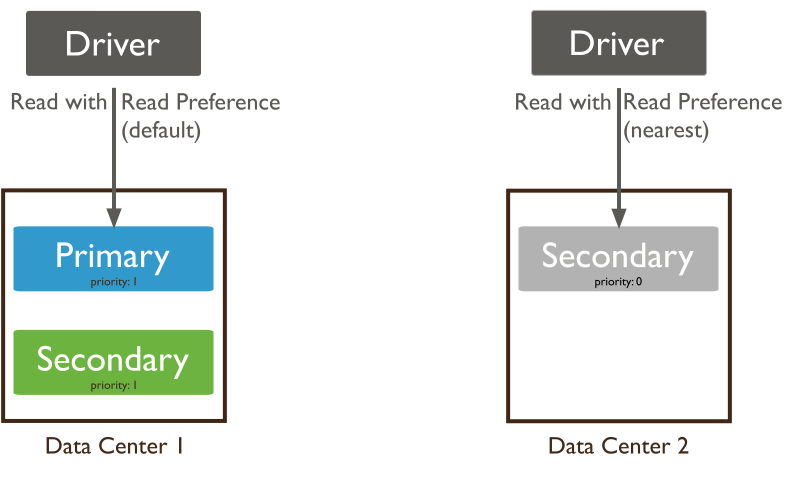
By default, an application directs its read operations to the primary member in a replica set (that is, read preference mode "primary"). But, clients can specify a read preference to send read operations to secondaries.
Read preference consists of the read preference mode and optionally, a tag set list, and the maxStalenessSeconds option.
Read Preference Modes
The following table summarizes the read preference modes.
Read Preference Mode | Description |
|---|---|
Default mode. Operations read from the current replica set primary. Transactions that contain read operations must use read preference | |
Operations read from the primary if it is available. If it isn't, they read from eligible secondary members. | |
Operations read from eligible secondary members of the replica set. | |
Operations read from an eligible member that has a network latency within the latency window, regardless of whether it is primary or secondary. |
For all modes, a member is available when it responds to the client's periodic monitoring checks, which confirm that the member is reachable over the network and able to respond to requests.
For all modes except
primary, a member is eligible if it satisfies the read preference's maxStalenessSeconds option and any specified tag set lists.For all modes except
primary, thelocalThresholdMSconnection string option sets the local threshold that the client uses to calculate the latency window when choosing among eligible members.
Important
Read preference modes provide no guarantee that an operation succeeds. Availability and eligibility determine which members the client considers, but a selected member can still reject an operation, such as when it is under load.
For detailed description of the read preference modes, see Read Preference Modes.
Behavior
All read preference modes except
primarymay return stale data because secondaries replicate operations from the primary in an asynchronous process. [1] Ensure that your application can tolerate stale data if you choose to use a non-primarymode.Read preference does not affect the visibility of data. Clients can see the results of writes before they are acknowledged or have propagated to a majority of replica set members. For details, see Read Isolation, Consistency, and Recency.
Read preference does not affect causal consistency. The causal consistency guarantees provided by causally consistent sessions for read operations with
"majority"read concern and write operations with"majority"write concern hold across all members of the MongoDB deployment.
Warning
Starting in MongoDB version 8.2, long-running secondary reads in a sharded cluster may automatically terminate before orphaned document deletion following a chunk migration.
The terminateSecondaryReadsOnOrphanCleanup parameter controls this behavior. To learn more about handling long-running secondary reads, see Long-Running Secondary Reads in Sharded Clusters.
Read Preference Modes
primaryAll read operations use only the current replica set primary. [1] This is the default read mode. If the primary is unavailable, read operations produce an error or throw an exception.
The
primaryread preference mode is not compatible with read preference modes that use tag set lists or maxStalenessSeconds. If you specify tag set lists or amaxStalenessSecondsvalue withprimary, the driver will produce an error.Transactions that contain read operations must use read preference
primary. All operations in a given transaction must route to the same member.
primaryPreferredOperations read from the primary member of the set if it is available. If the primary is unavailable, such as during failover situations, operations read from secondary members that satisfy the read preference's
maxStalenessSecondsand tag set lists.When the
primaryPreferredread preference includes a maxStalenessSeconds value and there is no primary from which to read, the client estimates how stale each secondary is by comparing the secondary's last write to that of the secondary with the most recent write. The client then directs the read operation to a secondary whose estimated lag is less than or equal tomaxStalenessSeconds.When the read preference includes a tag set list (an array of tag sets) and there is no primary from which to read, the client attempts to find secondary members with matching tags (trying the tag sets in order until a match is found). If matching secondaries are found, the client selects a random secondary from the nearest group of matching secondaries. If no secondaries have matching tags, the read operation produces an error.
When the read preference includes a
maxStalenessSecondsvalue and a tag set list, the client filters by staleness first and then by the specified tags.Read operations using the
primaryPreferredmode may return stale data. Use themaxStalenessSecondsoption to avoid reading from secondaries that the client estimates are overly stale.In sharded clusters that enable the ingress request rate limiter, shard nodes that are shedding load can return errors labeled
SystemOverloadedError.For clusters that have
overloadAwareServerSelectionEnabledset totrue, when a primary responds with a retryable error labeled withSystemOverloadedError, the router may temporarily route reads to eligible secondaries instead of the overloaded server. This applies to any read preference that can select multiple servers. By default,overloadAwareServerSelectionEnabledis set tofalse.
secondaryOperations read only from the secondary members of the set. If no secondaries are available, then this read operation produces an error or exception.
Most replica sets have at least one secondary, but there are situations where there may be no available secondary. For example, a replica set with a primary, a secondary, and an arbiter may not have any secondaries if a member is in recovering state or unavailable.
When the
secondaryread preference includes a maxStalenessSeconds value, the client estimates how stale each secondary is by comparing the secondary's last write to that of the primary. The client then directs the read operation to a secondary whose estimated lag is less than or equal tomaxStalenessSeconds. If there is no primary, the client uses the secondary with the most recent write for the comparison.When the read preference includes a tag set list (an array of tag sets), the client attempts to find secondary members with matching tags (trying the tag sets in order until a match is found). If matching secondaries are found, the client selects a random secondary from the nearest group of matching secondaries. If no secondaries have matching tags, the read operation produces an error.
When the read preference includes a
maxStalenessSecondsvalue and a tag set list, the client filters by staleness first and then by the specified tags.Read operations using the
secondarymode may return stale data. Use themaxStalenessSecondsoption to avoid reading from secondaries that the client estimates are overly stale.
secondaryPreferredOperations read data from eligible secondary members of the replica set. If no eligible secondaries are available, operations read from the primary member.
When the
secondaryPreferredread preference includes a maxStalenessSeconds value, the client estimates how stale each secondary is by comparing the secondary's last write to that of the primary. The client then directs the read operation to a secondary whose estimated lag is less than or equal tomaxStalenessSeconds. If there is no primary, the client uses the secondary with the most recent write for the comparison. If there are no secondaries with estimated lag less than or equal tomaxStalenessSeconds, the client directs the read operation to the replica set's primary.When the read preference includes a tag set list (an array of tag sets), the client attempts to find secondary members with matching tags (trying the tag sets in order until a match is found). If matching secondaries are found, the client selects a random secondary from the nearest group of matching secondaries. If no secondaries have matching tags, the client ignores tags and reads from the primary.
When the read preference includes a
maxStalenessSecondsvalue and a tag set list, the client filters by staleness first and then by the specified tags.Read operations using the
secondaryPreferredmode may return stale data. Use themaxStalenessSecondsoption to avoid reading from secondaries that the client estimates are overly stale.
nearestThe driver reads from a member whose network latency falls within the acceptable latency window. Reads in the
nearestmode do not consider whether a member is a primary or secondary when routing read operations: primaries and secondaries are treated equivalently.Set this mode to minimize the effect of network latency on read operations without preference for current or stale data.
When the read preference includes a maxStalenessSeconds value, the client estimates how stale each secondary is by comparing the secondary's last write to that of the primary, if available, or to the secondary with the most recent write if there is no primary. The client will then filter out any secondary whose estimated lag is greater than
maxStalenessSecondsand randomly direct the read to a remaining member (primary or secondary) whose network latency falls within the acceptable latency window.If you specify a tag set list, the client attempts to find a replica set member that matches the specified tag set lists and directs reads to an arbitrary member from among the nearest group.
When the read preference includes a
maxStalenessSecondsvalue and a tag set list, the client filters by staleness first and then by the specified tags. From the remainingmongodinstances, the client then randomly directs the read to an instance that falls within the acceptable latency window. The read preference member selection documentation describes the process in detail.Read operations using the
nearestmode may return stale data. Use themaxStalenessSecondsoption to avoid reading from secondaries that the client estimates are overly stale.
Tip
To learn about use cases for specific read preference settings, see Read Preference Use Cases.
Configure Read Preference
When using a MongoDB driver, you can specify the read preference using the driver's read preference API. See the driver API documentation. You can also set the read preference when connecting to the replica set or sharded cluster. For an example, see connection string.
For a given read preference, the MongoDB drivers use the same member selection logic.
When using mongosh, see cursor.readPref() and Mongo.setReadPref().
Read Preference and Transactions
Transactions that contain read operations must use read preference primary. All operations in a given transaction must route to the same member.
Additional Considerations
Consider the following points when using $merge or $out stages in an aggregation pipeline:
Starting in MongoDB 5.0, pipelines with a
$mergestage can run on replica set secondary nodes if all the nodes in the cluster have the featureCompatibilityVersion set to5.0or higher and the read preference allows secondary reads.In earlier MongoDB versions, pipelines with
$outor$mergestages always run on the primary node and read preference isn't considered.
For mapReduce operations, only "inline" mapReduce operations that do not write data support read preference. Otherwise, mapReduce operations run on the primary member.
| [1] | (1, 2) In some circumstances, two nodes in a replica set may transiently believe that they are the primary, but at most, one of them will be able to complete writes with |