Note
Aggregation Pipeline as Alternative
Starting in MongoDB 5.0, map-reduce is deprecated:
Instead of map-reduce, you should use an aggregation pipeline. Aggregation pipelines provide better performance and usability than map-reduce.
You can rewrite map-reduce operations using aggregation pipeline stages, such as
$group,$merge, and others.For map-reduce operations that require custom functionality, you can use the
$accumulatorand$functionaggregation operators. You can use those operators to define custom aggregation expressions in JavaScript.
For examples of aggregation pipeline alternatives to map-reduce, see:
Map-reduce is a data processing paradigm for condensing large volumes of data into aggregated results. To perform map-reduce operations, MongoDB provides the mapReduce database command.
Consider the following map-reduce operation:
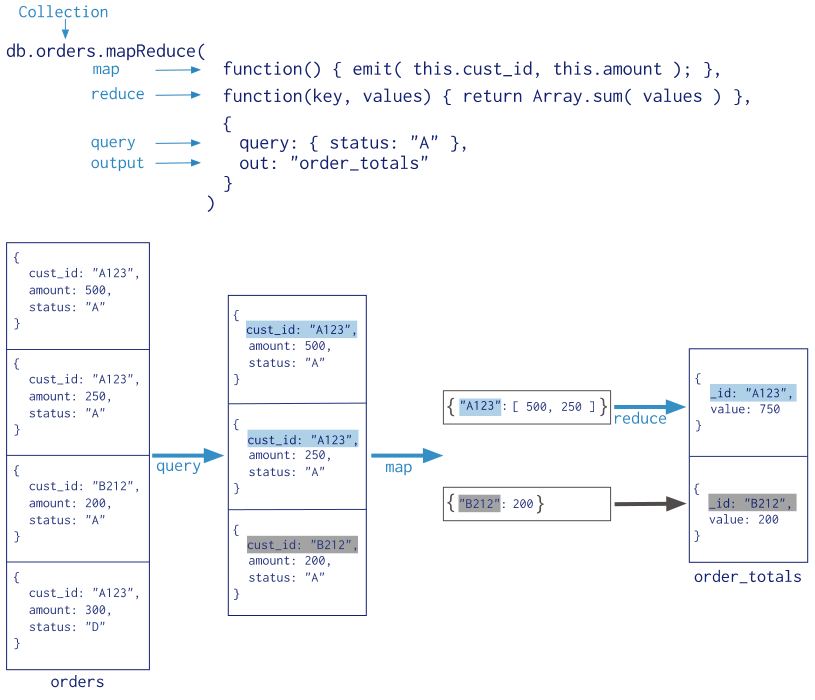
MongoDB applies the map phase to each input document (the documents in the collection that match the query condition). The map function emits key-value pairs. For keys that have multiple values, MongoDB applies the reduce phase, which collects and condenses the data, and then stores the results in a collection. The output of the reduce function can optionally pass through a finalize function to further process the results.
All map-reduce functions in MongoDB are JavaScript and run within the mongod process. Map-reduce operations take a single collection as input and can apply sorting and limiting before the map stage. mapReduce can return results as a document or write them to a collection.
Note
Map-reduce is unsupported for MongoDB Atlas Free and Flex clusters.
Map-Reduce JavaScript Functions
Map-reduce operations use custom JavaScript functions to map values to a key. If a key has multiple values, the operation reduces them to a single object. A map function can emit multiple key-value pairs or none. An optional finalize function can make further modifications to the results.
Map-Reduce Results
A map-reduce operation can write results to a collection or return them inline. If you write results to a collection, you can run subsequent map-reduce operations against the same input collection that replace, merge, or reduce new results with previous results. See mapReduce and Perform Incremental Map-Reduce for examples.
When returning results inline, the result documents must fit within the BSON Document Size limit of 16 mebibytes. For more limits and restrictions, see mapReduce.
Sharded Collections
MongoDB supports map-reduce operations on sharded collections.
Views
Views do not support map-reduce operations.