References store relationships between data by including links, called
references, from one document to another. Applications can resolve these
references to access the related data. In the following example,
the contact and access documents contain a reference to the
user document.
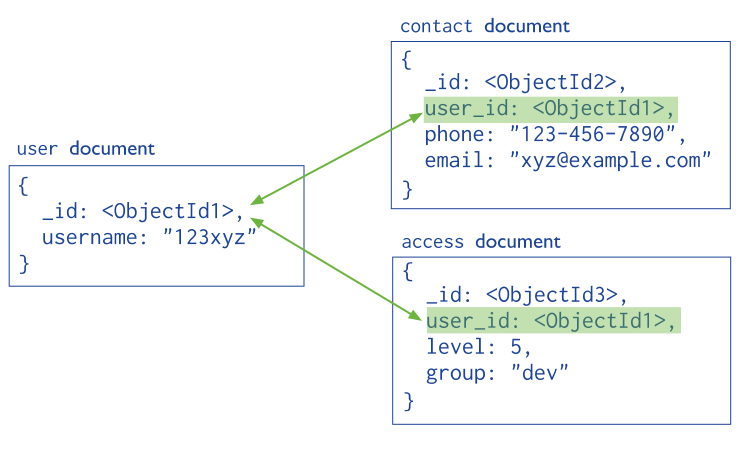
References result in normalized data models because data is divided into multiple collections and not duplicated.
Use Cases
Although a denormalized data models work for most use cases in MongoDB, consider using references instead of embedded data if:
Embedding would result in duplication of data but would not provide sufficient read performance advantages to outweigh the implications of the duplication. For example, when the embedded data frequently changes.
You need to represent complex many-to-many relationships or large hierarchical data sets.
You need to frequently query the related entity on its own.
Large Number of Collections
In certain situations, you might choose to store related information in several collections rather than in a single collection.
Consider a sample collection logs that stores log documents for
various environment and applications. The logs collection contains
documents of the following form:
{ log: "dev", ts: ..., info: ... } { log: "debug", ts: ..., info: ...}
If the total number of documents is low, you may group documents into
collection by type. For logs, consider maintaining distinct log
collections, such as logs_dev and logs_debug.
Generally, having a large number of collections has no significant performance penalty and results in good performance. Distinct collections are very important for high-throughput batch processing.
When using models that have a large number of collections, consider the following behaviors:
Each collection has a certain minimum overhead of a few kilobytes.
Unindexed read operations might consume a large amount of memory.
For each database, a single namespace file (such as
<database>.ns) stores all metadata for that database. Each index and collection has its own entry in the namespace file. See places namespace length limits for specific limitations.
Query Normalized Data Models
To query normalized data in multiple collections, MongoDB provides the following aggregation stages:
For an example of normalized data models, see Model One-to-Many Relationships with Document References.
For examples of various tree models, see Model Tree Structures.