Learn how to use MongoDB to manage fleets of connected vehicles, optimize route planning, and improve driver safety.
Use cases: App Driven-Analytics, Gen AI, IoT
Industries: Manufacturing & Motion
Products and tools: Atlas Database, Atlas Vector Search
Solution Overview
In this solution, we build an AI-powered Connected Fleet Advisor built using MongoDB Atlas, Voyage AI, OpenAI, and LangGraph.
The system receives driver complaints or fleet manager queries, processes vehicle telemetry data, generates a chain-of-thought, performs a vector search for similar issues, persists the data in MongoDB, and finally produces a diagnostic recommendation using an OpenAI LLM.
An agent is an operational application that attempts to achieve a goal by observing the world and acting upon it using the data and tools it has at its disposal. The term "agentic" denotes having agency as an AI agent, proactively taking steps to achieve objectives without constant human oversight. For example, rather than just reporting an anomaly based on connected car telemetry data analysis, an agentic AI system for a connected fleet autonomously cross-checks that anomaly against known issues, decides whether it's critical, and schedules a maintenance appointment all on its own.
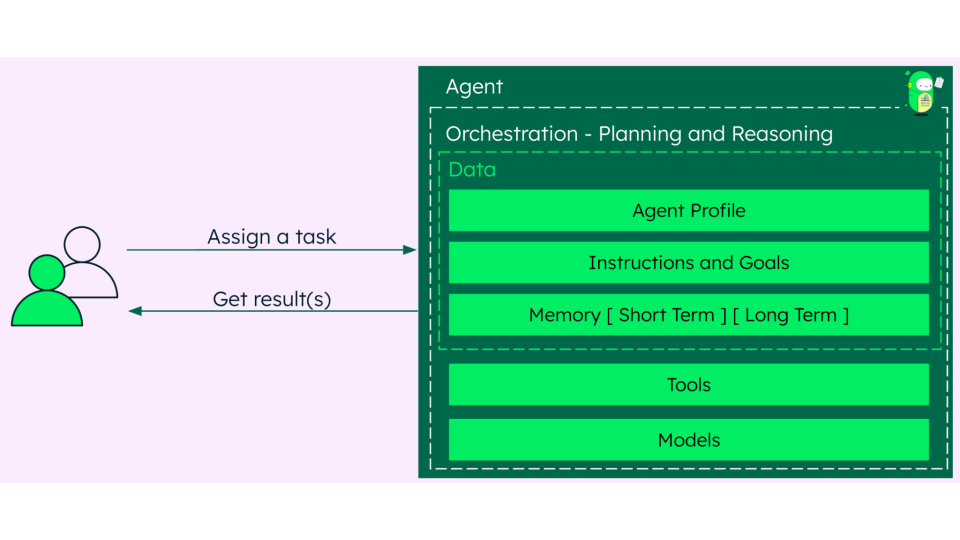
Figure 1. Basic components of an AI agent
Future Growth and Challenges
The automotive and mobility industry is undergoing a significant transformation, driven by advancements in vehicle connectivity, autonomous systems, shared mobility, and electrification. Vehicles are now sophisticated machines that generate massive amounts of data. Automotive demand grows by 3% annually over the next 20 years with increased preference towards connected and electric vehicles. Automotive players embrace artificial intelligence (AI), battery electrical vehicles (BEVs) and software-defined vehicles (SDVs) to maintain their competitive advantage. The global connected vehicles market size expects to reach around USD 446.6 billion by 2033, growing at a CAGR of 19.5% between 2024 to 2033. Managing fleets of connected vehicles presents a challenge. As cars get more sophisticated and integrate with internal and external systems, the volume of data increases. You need to store, transfer, and consume this data with various downstream applications to unlock new business opportunities. The global fleet management market projects to reach USD 65.7 billion by 2030, growing at a rate of almost 10.8% annually.
A 2024 study conducted by Webfleet revealed that 32% of fleet managers believe AI and machine learning will significantly impact fleet operations in the coming years. This narrowly surpasses the 30% who cited EVs as the primary game-changer. Optimising route planning and improving driver safety are the two most commonly cited ways fleet managers believe AI changes their working day. As fleet management software providers continue to invest in AI, integrating agentic AI, autonomous systems capable of making real-time decisions, can significantly help with use cases like route optimization and driver safety enhancement. For example, AI agents process real-time traffic updates and weather conditions to dynamically adjust routes, ensuring timely deliveries while advising drivers on their car condition as needed. This proactive approach contrasts with traditional reactive methods, improving vehicle utilization and reducing operational and maintenance costs.
Reference Architectures
The reference architecture shown below illustrates the inner workings and data flow of the AI agent. The workflow begins when a user, a driver, submits a query about a potential issue. For example, hearing a knocking sound. The LangGraph-based agent orchestrator then processes this request using an LLM (OpenAI GPT-4o) to interpret the request and create a chain of thought (CoT) reasoning and workflow. The workflow executes by the agent using tools such as Atlas Vector Search.
The agent processes an issue report, as follows:
Reads telemetry data: Ingests vehicle sensor data from a CSV file (or an API in a production setup).
Generates an embedding: Uses Voyage AI embedding API to convert the complaint text into a numerical representation.
Uses Atlas Vector Search: Searches for similar issues in MongoDB Atlas using the generated embedding.
Persists data: Saves telemetry data, session logs, and recommendations in MongoDB Atlas.
Provides a final recommendation: Uses OpenAI chat API to produce actionable diagnostic advice.
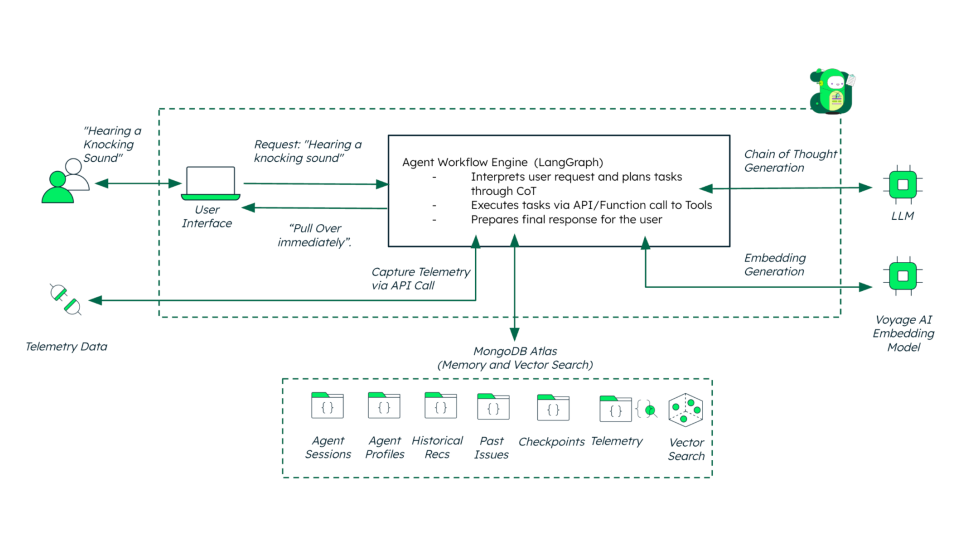
Figure 2. Reference architecture of the proposed solution
Data Model Approach
An agent requires different types of data to function. MongoDB's document model allows you to easily model all of this data in one database. Below you find one example per different data type found in an agentic AI application for fleet management. Notice how the flexibility of the document model adapts to suit the type of data required for storage.
Agent Profile
This data contains the identity of the agent, including instructions, goals and constraints.
Example of an Agent Profile
{ "_id": "67c20cf886f35bcb8c71e53c", "agent_id": "default_agent", "profile": "Default Agent Profile", "instructions": "Follow diagnostic procedures meticulously.", "rules": "Ensure safety; validate sensor data; document all steps.", "goals": "Provide accurate diagnostics and actionable recommendations." }
Short-term Memory
Short-term memory holds temporary, contextual information—recent data inputs or ongoing interactions—that the agent uses in real-time. For example, short-term memory stores sensor data from the last few hours of vehicle activity. In certain agentic AI frameworks like LangGraph, short-term memory implements through a checkpointer. The checkpointer stores intermediate states of the agent's actions and reasoning. This memory allows the agent to seamlessly pause and resume operations.
Example of short-term memory: Telemetry data stored in time series collections
{ "_id": "67cb23ee370eb8f40c9bf677", "timestamp": "2025-02-19T13:00:00", "vin":"5TFUW5F13CX228552", "engine_temperature": "90", "oil_pressure": "35", "avg_fuel_consumption": "8.5", "thread_id": "thread_20250307_125027" }
Long-term Memory
Long-term memory stores accumulated knowledge over time for the agent. This may include patterns, trends, logs, historical recommendations, and decisions.
Example of long-term memory: Historical issues with connected vehicles vectorized and stored in MongoDB
{ "_id": "67ca173679c7c286f44f4a24", "issue": "Engine knocking when turning", "recommendation": "Inspect spark plugs and engine oil.", "embedding": [ -0.021414414048194885, -0.0031116530299186707, 0.014275052584707737, -0.030444633215665817, 0.018614845350384712, 0.06425976008176804, 0.0060801152139902115, -0.012883528135716915, -0.007000760640949011, -0.04991862177848816, ... ] }
Build the Solution
To build this solution, follow the instructions in the Fleet Management Agent GitHub repository. The repository provides step-by-step guidance for setting up the application.
Prerequisites
Python 3.11+ (backend)
Node.js (for the Next.js frontend)
MongoDB Atlas account
OpenAI API Key
Voyage AI API Key
System Architectures
Backend Workflow
You implement a multi-step diagnostic workflow using LangGraph, as follows:
The agent receives a driver's issue report. For example, "My vehicle's fuel consumption has increased significantly over the past week. What might be wrong with the engine or fuel system?".
The agent retrieves telemetry data and logs the update.
The agent generates an embedding for the complaint using Voyage AI voyage-3-large embedding API.
The system then performs a vector search against historical issues in MongoDB to find similar cases.
MongoDB stores all telemetry, embeddings, and session logs to ensure traceability.
Finally, the agent uses OpenAI's ChatCompletion API to produce a final recommendation.
MongoDB Atlas
The flexible document model database stores agent profiles, historical recommendations, telemetry data, session logs, and more. This persistent storage logs every step of the diagnostic process for traceability and enables efficient querying and reusability of past data, makeing the system highly traceable and scalable.
Frontend Interface
The Next.js frontend provides a two-column view:
Left column: Displays the real-time agent workflow updates such as the chain-of-thought reasoning, update messages, and final recommendations.
Right column: Shows the documents inserted into MongoDB during the agent run, including session details, telemetry logs, historical recommendations, agent profiles, and sample past issues.
Set Up the Application
To set up the application, perform the following steps:
Configure environment variables
Create a .env file in the backend directory with the following content:
OPENAI_API_KEY=your_openai_api_key_here VOYAGE_API_KEY=your_voyage_api_key_here MONGO_URI=your_mongo_uri_here DATABASE=fleet_issues TELEMETRY_PATH=data/telemetry_data.csv VECTOR_SEARCH_INDEX=issues_index
Create an Atlas Vector Search index with name issues_index and path embeddings
For more details on how to set up Vector Search index, see Create Vector Search Indexes.
Feel free to adjust the prompt in main.py or update the telemetry data in the telemetry_data.csv file.
Explore the Solution
Start a New Diagnosis
Open the frontend and choose "New Diagnosis".
Enter an issue report in the text box, for example:
I hear a knocking sound while turning at low speeds.
My car makes a persistent rattling noise when I accelerate at low speeds.
I noticed a sudden drop in oil pressure with a slight rise in engine temperature.
My vehicle's fuel consumption increased significantly over the past week. What might be wrong with the engine or fuel system?
A warning light recently appeared on my dashboard, and the car struggles to accelerate.
Click the "Run Agent" button and wait for a minute or two as the agent finishes its run.
Check the Workflow
The workflow, chain-of-thought output, and the final recommendation display in the left column.
The workflow generates in real time, giving transparency into the agent's decision-making process.
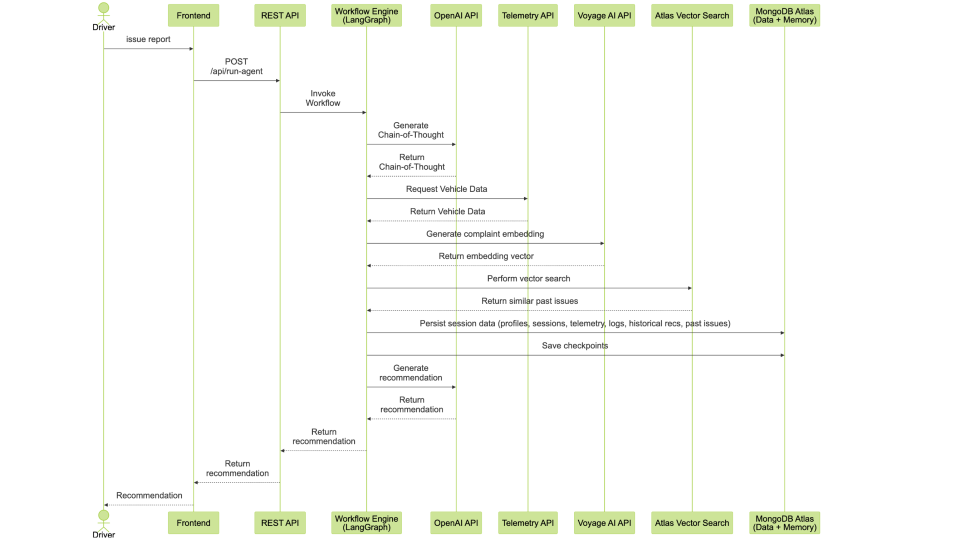
Figure 3: Sequence diagram of AI agent workflow
Review the MongoDB Documents
In the right column, the documents shown are the records inserted during the current agent run:
agent_sessions: Contains session metadata and the thread ID.
historical_recommendations: Stores the final recommendations and related diagnostics.
telemetry_data: Holds the telemetry sensor readings.
logs: Contains log entries for the diagnostic process.
agent_profiles: Shows the agent's profile that was used during diagnosis.
past_issues: (If available) Displays a sample of historical issues.
checkpoints: (From the checkpointing database) Shows the last saved state for potential recovery.
Resume Functionality
Optionally, we can demonstrate the "Resume Diagnosis" feature by entering a thread ID and showing how the system retrieves the corresponding session.
Key Learnings
Scalability and flexibility: Connected car platforms such as fleet management systems handle extreme data volumes and variety. MongoDB Atlas scales horizontally across cloud clusters, letting you ingest millions of telemetry events per minute and store terabytes of telemetry data. For example, ZF SCALAR uses MongoDB to process 90,000 vehicle messages per minute (over 50 GB of data per day) from hundreds of thousands of connected cars. The MongoDB document model adapts as the fleet grows. You can evolve schemas as vehicles add new sensors or features. This flexibility accelerates development and ensures your data model stays aligned with the real-world entities such as vehicles, trips, or incidents that it represents.
Implement built-in vector search: AI Agents require a robust set of tools to work with. Vector search allows agents to semantically search on unstructured data such as driver logs, error codes descriptions, and repair manuals. MongoDB Atlas has native support for vector search, which stores and indexes high-dimensional vectors alongside your operational data and performs fast similarity queries over them. In practice, this means your AI embeddings live next to the relevant vehicle telemetry and operational data in the database. This simplifies architectures for use cases such as the connected car incident advisor, where an issue can match against past issues encountered before passing the context to LLM. (See how an automotive OEM leverages vector search for audio based diagnostics with MongoDB Atlas Vector Search).
Deploy time series collections and real-time data processing: MongoDB Atlas is designed for real-time applications. It provides time series collections for connected car telemetry data storage, change streams, and triggers that react to new data instantly. Given that real-time visibility is a top feature in modern fleet management systems, MongoDB's ability to serve immediate insights to the AI agents ensures the decisions they make are based on the latest information. This is crucial for agentic AI feedback loops, where ongoing data ingestion and learning happen continuously.
Use best-in-class embedding models with Voyage AI: MongoDB recently acquired Voyage AI, who specializes in embedding and reranking models. As MongoDB Atlas integrates Voyage AI embedding models, developers no longer need to manage external embedding APIs, standalone vector stores, or complex search pipelines. AI retrieval becomes built into the database itself, making semantic search, vector retrieval, and ranking as seamless as traditional queries. This reduces the time required for developing Agentic AI applications.
Author
Humza Akhtar, MongoDB