Capital markets run on massive amounts of data that is complex and mission-critical. Every day, exchanges, clearing houses, and broker-dealers handle millions of messages, trades, and risk events across front, middle, and back-office systems. But legacy architectures built on rigid, siloed relational databases are reaching their limits, unable to keep pace with the demands of real-time analytics, horizontal scalability, and AI-driven market intelligence.
MongoDB’s modern data platform provides a flexible and resilient foundation that today’s capital markets require. It empowers institutions to operate at market speed while simplifying integration across trading, risk, and post-trade environments. With native support for unstructured data alongside structured market data in real-time, MongoDB future-proofs market infrastructure for the next era of data and AI innovation. The evolving data demands of capital markets are driving the need for unified and intelligent data platforms.
Deloitte’s 2026 banking and capital markets outlook report¹ presents the importance of having an AI-ready infrastructure. While cloud migration and regulatory investments have improved traceability and governance, many banks still struggle with siloed, slow, and incomplete data that undermines model accuracy, experimentation velocity, and regulatory confidence. Deloitte finds that over 90% of banking data users report data being unavailable or too slow to access, and more than 80% cite data quality as a top challenge. As AI moves from pilots to enterprise-scale and agentic use, capital markets firms must modernize their data foundations to deliver trusted, timely, richly contextualized, and securely governed data across the organization. This is where modern, flexible data platforms like MongoDB become critical, enabling institutions to unify fragmented data, operationalize governance, and build an AI-ready foundation designed for speed, scale, and trust.
Unified data layer for trading and clearing
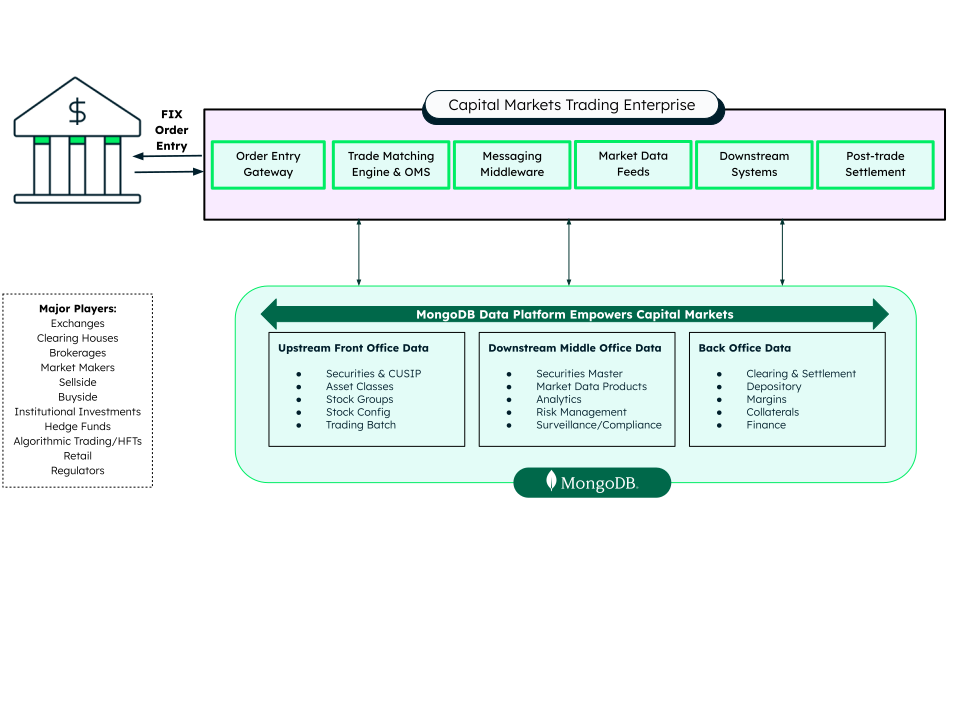
MongoDB acts as a unified operational data platform, connecting front, middle, and back office data domains. The architecture supports both real-time operational workloads and AI/analytics use cases across trading, market data, risks, and clearing functions.
MongoDB transforms this landscape with a flexible, high-performance data foundation that seamlessly connects trading, risk, and operations and enables real-time analytics, flexible data handling, resilience, and unconstrained scalability.
Key MongoDB capabilities for capital markets
1. Unified, high-performance, low-latency data platform
MongoDB is built to provide low latency and best performance for high-throughput capital markets platforms. MongoDB’s document model can underpin order management systems and trade and order life cycle management. An efficient JSON data model that supports nested data relationships in a consolidated business object not only drives development agility but also optimizes the data ingestion and retrieval performance.
Example: User interfaces built on MongoDB can visualize a real-time order book where trades and quotes are processed and retrieved instantly, supporting traders' dashboards, charts, trade desk, and market administration with no delays.
2. Integrated AI, search, and analytics capabilities
MongoDB brings together operational data, AI frameworks, search capabilities (full-text and vector search), and analytics within the same platform. It eliminates data movement across systems and unlocks frictionless delivery. Together with this, the aggregation framework eliminates the need to move data between systems, speeding up insights and enabling a seamless connection between operational and analytical workloads.
MongoDB offers an AI-ready architecture that empowers building AI-powered applications seamlessly and with agility.
Example: A compliance analyst can use semantic vector search over millions of unstructured messages, communication logs, and trade reports to identify potential patterns of trading risks. Further can combine it with AI capabilities to drive intelligent and actionable insights.
3. Resilience, availability, and scalability built-in
MongoDB’s architecture ensures high availability, resilience, and horizontal scalability, essential for maintaining always-on market operations and handling exponential data growth.
MongoDB replica sets and global clusters ensure continuous uptime and automatic failover across regions, which is transparent to the applications and essential for always-on market operations.
Example: A clearing house can achieve uninterrupted settlement processing across multiple geographies, even during regional outages or infrastructure failures.
MongoDB sharding allows scaling horizontally to handle large market transaction volumes and data growth without re-architecting or compromising performance, and is seamless to the applications.
Example: A broker-dealer can scale seamlessly during peak trading hours or IPO events when trade volumes surge 10x, ensuring consistent throughput and low latency.
4. Intelligent time-series and real-time data processing
High-performance MongoDB native time-series collections enable institutions to efficiently store and analyze sequential data such as market prices, quotes, and trade statistics. Native optimizations for time-series data allow for faster queries and smaller storage footprints, critical for supporting real-time AI workloads and anomaly detection.
Example: With MongoDB Time Series collections, a market surveillance platform can store, retrieve, and analyze billions of tick messages per day to detect anomalies or potential unusual trading patterns in real time.
5. Security & compliance by design
MongoDB end-to-end data encryption, queryable encryption, client-side field-level encryption, role-based access control, auditing, and regional data residency options align with financial regulatory standards.
Example: A capital markets firm can ensure regulatory compliance, such as SEC or MiFID, by securing sensitive trade data and maintaining auditable data access trails across all environments while maintaining best practices for security.
Capital markets data stack
Exchanges and clearing houses power the heartbeat of global markets, processing trillions in daily trading volume while orchestrating complex workflows from real-time order matching to post-trade settlement. Yet, traditional relational databases are straining under modern pressures, exponential data growth, diverse unstructured feeds, AI-driven insights, and the demand for unified visibility across front, middle, and back offices. MongoDB empowers capital markets institutions to modernize the full trading and clearing lifecycle, driving speed, transparency, and intelligence across every layer of the stack.
Front-Office: market connectivity, order management, and real-time analytics
Traders, algorithms, and execution platforms thrive on speed and flexibility. MongoDB powers order management systems (OMS) by ingesting market data into flexible documents and time series collections. No need for rigid schemas to map every tick. Just store raw JSON and query it instantly. Front-office systems require real-time data analytics and data processing for immediate insights, which is crucial for trading and market data applications.
Use case: With MongoDB, the order management systems store each order and execution event in a flexible JSON structure with nested attributes (order type, venue, algo parameters), easily joined with reference and market data in real-time dashboards.
Middle-Office: risk, compliance, and surveillance
Middle-office systems manage customer data, account information, and transaction histories. The platform's flexibility helps adapt to evolving regulations and business requirements by accommodating changes in data structures. Middle-office functions like risk assessment, position management, and compliance demand a 360-degree view of the trades. MongoDB unifies disparate data sources, such as client information, market metrics, and transaction logs, into a consolidated view, eliminating traditional data silos created by legacy systems.
Use case: MongoDB Single View enables faster risk calculations and regulatory reporting. For risk management professionals, this means real-time surveillance and faster action without slow ETL external processing powered by MongoDB aggregation pipelines. Enhancing market regulatory compliance and minimizing risk exposures.
Back-Office: settlement, reconciliation, and regulatory reporting
The back office in capital markets is responsible for post-trade operations, ensuring that every executed trade is accurately confirmed, settled, and recorded. These processes involve high-volume, audit-intensive workflows that demand precision, traceability, and speed. MongoDB provides a flexible and resilient data foundation for clearing and settlement systems, enabling institutions to store settlement confirmations as rich documents while using change streams for real-time reconciliation and exception handling, ensuring operational integrity across the entire clearing workflow lifecycle.
Use case: Clearing houses or brokers can use MongoDB as a unified and nested JSON data linking trades, positions, margin requirements, and collateral balances, all updated continuously from upstream systems. Ingesting trades, clearing confirmations, and settlement reports from multiple systems. This streamlines T+1 or even real-time settlement processes.
Future outlook: AI as the next catalyst in capital markets
As capital markets embrace the era of AI, data becomes more than an asset; it becomes intelligence in motion. MongoDB provides the foundation for this transformation, enabling vector search, semantic retrieval, gen AI, agentic AI, and integration directly within the data layer. For exchanges, clearing houses, and broker-dealers, this means building agentic AI systems that can analyze, reason, and act across trading, risk, and operations from automated risk monitoring to personalized trading strategies. With MongoDB as the AI data backbone, capital markets are poised to significantly evolve toward greater flexibility with a higher degree of autonomy and intelligent decision-making at scale.
Next Steps
- Explore how MongoDB is used to accelerate Stablecoin Innovation in US Banking.
- Curious about MongoDB's role in digital assets? Discover key insights in our blog: Powering the Next Generation of Digital Assets Platforms with MongoDB.
- Learn how MongoDB drives transformation in the financial sector. Visit our Capital Markets page.
- See MongoDB in action! Discover how Morningstar modernized its API platform with MongoDB Atlas.