Day 14 of 100daysofcode : SOLID Principles in Software Development
Today, I’m diving into SOLID principles, a cornerstone of clean and maintainable software design. Let’s break them down with more details and relatable real-life examples:
- What Are SOLID Principles?
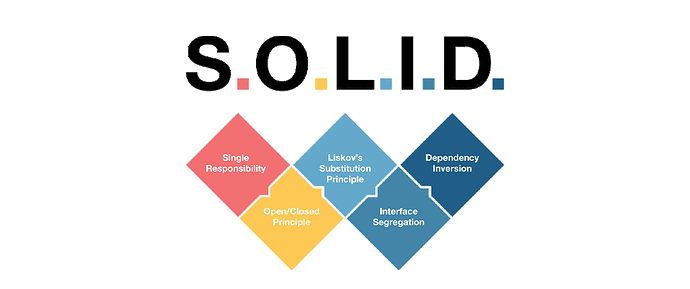
SOLID is an acronym for five design principles that help developers write scalable, robust, and maintainable code. Here are the principles:
1.1. S - Single Responsibility Principle (SRP):
-Definition: A class should have only one responsibility or reason to change.
-Real-life example: Imagine a library system. A class that handles book inventory should not also handle user membership. If the library decides to change its membership policy, it shouldn’t affect how books are managed.
1.2. O - Open/Closed Principle (OCP):
-Definition: Software entities should be open for extension but closed for modification
-Real-life example: Consider an online shopping platform where new payment methods (like Apple Pay or Google Pay) are introduced. Instead of modifying the existing payment processing system, you can extend it by adding new modules for each payment method.
1.3. L - Liskov Substitution Principle (LSP):
-Definition: Subtypes must be substitutable for their base types without altering the correctness of the program.
-Real-life example: In a ride-sharing app, a base class Vehicle could have subtypes like Car, Bike , or Electric Scooter . Any vehicle should work seamlessly within the app’s logic, regardless of its type.
1.4. I - Interface Segregation Principle (ISP):
-Definition: A class should not be forced to implement interfaces it does not use.
-Real-life example: Think of a smart home system. A light bulb controller interface should not require methods to control a thermostat. Each device should have its own specific interface.
1.5. D - Dependency Inversion Principle (DIP):
-Definition: High-level modules should not depend on low-level modules; both should depend on abstractions.
-Real-life example: In an e-commerce platform, the order processing system (high-level module) should depend on an abstraction of a payment gateway rather than directly on a specific provider like PayPal. This allows for easily swapping providers without affecting the rest of the system.
- Benefits of Applying SOLID Principles:
2.1. Improved Code Quality: Makes code cleaner and more understandable.
2.2. Ease of Maintenance: Reduces the cost and complexity of modifying code.
2.3. Enhanced Scalability: Supports the addition of new features without disrupting existing ones.
2.4. Minimized Bugs: Promotes writing predictable and robust systems.
By integrating these principles into your development practices, you’ll build software that’s easier to manage and scale in the long run.
100daysofcode lebanon-mug